3 min read

The Guide to Writing a Trade Show Exhibit Design Brief

trade show booth designs

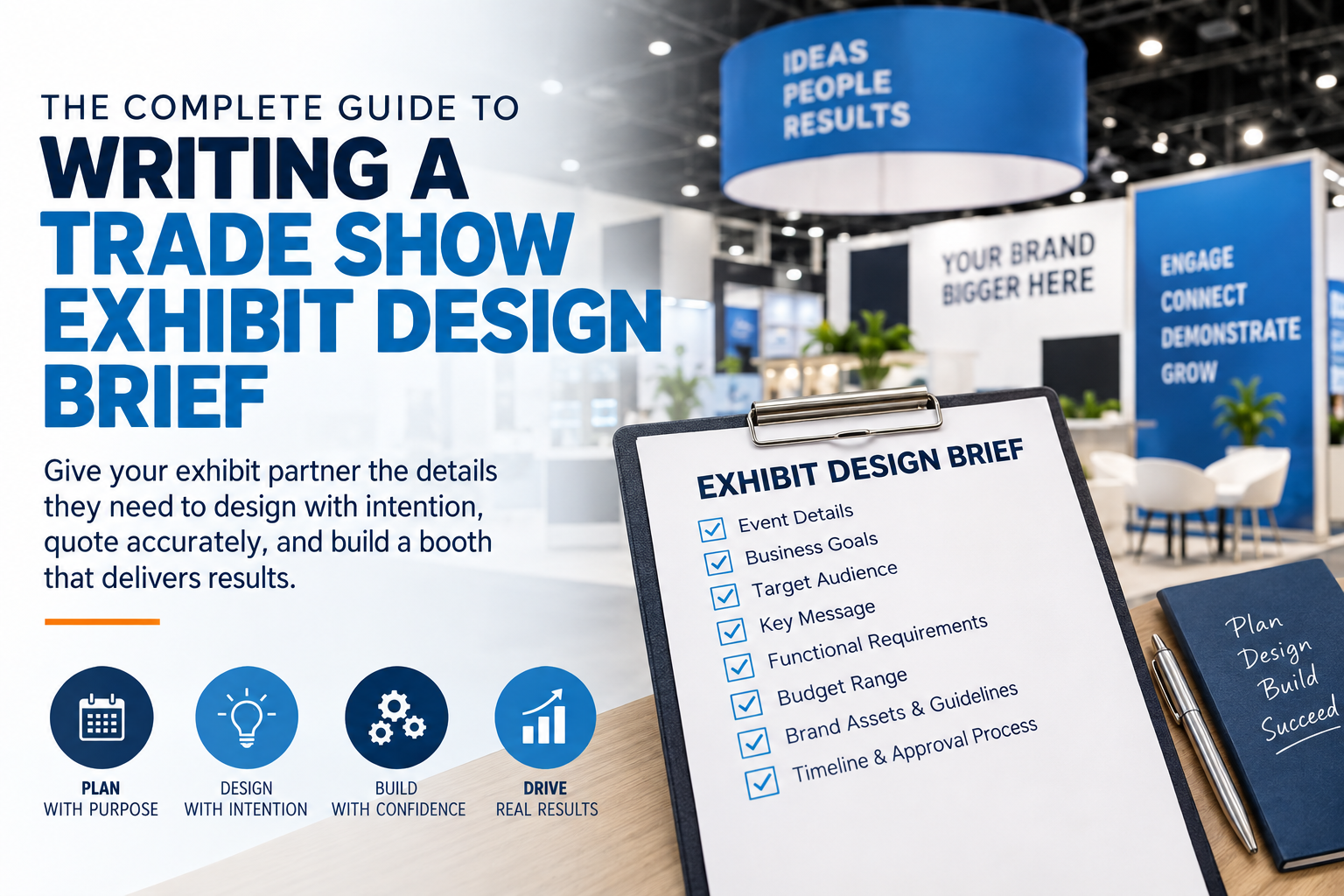
Just having a discussion on your exhibit needs forces your exhibit partner to guess — and guessing shows up everywhere you do not want it to: in longer revision cycles, preventable cost increases, missed expectations, and a booth that looks acceptable on paper but falls short on the show floor. A solid design brief changes that. It gives your team and your exhibit partner the information needed to design with intention, quote accurately, and build without last-minute scrambling. Instead of spending time backtracking through unanswered questions, everyone can move forward with a clear understanding of the goals, constraints, and must-haves from the start.

Most companies spend weeks debating messaging, booth size, and budget internally — then hand their exhibit partner a two-line email and expect a great design to come back. It doesn't work that way. Design and fabrication teams can only build to the level of detail they're given. Skip the brief, or write a thin one, and you end up paying for it later: extra revision rounds, change orders once fabrication is already underway, and a booth that technically checks the boxes but doesn't actually work the way you needed it to. A brief takes an afternoon to put together. Fixing a booth that missed the mark takes a lot longer, and costs a lot more.

What a Design Brief Actually Isexhibit design brief

At its core, a design brief is a short document answering four questions: what you need, why you need it, who it's for, and what success looks like. It covers your goals, audience, booth footprint, budget, timeline, brand standards, functional requirements, and any experiences you consider non-negotiable.

It's not a creative writing exercise — it's the reference point that keeps everyone (your internal stakeholders, your designers, your fabricators) working from the same information from day one.

What to Put in the Brief

1. Event Details
Lay out the fundamentals so nobody has to chase them down later: show name, dates, venue and city, booth dimensions and layout, booth number if you have one, move-in/move-out windows, and any exhibitor manual rules that affect design or install. These details ripple into engineering, shipping, labor, and cost — get them locked in early.

2. Business Goals
"Brand awareness" isn't a goal, it's a placeholder. Get specific. A booth built to generate leads needs a different layout than one built for live product demos, and a hospitality-focused space needs different traffic flow than a high-activity activation. Your goals should directly shape the design brief, not sit off to the side.

3. Target Audience
Who has to walk in and immediately care? Define job titles, industries, pain points, and where they are in the buying journey. A booth trying to speak to everyone usually connects with no one — the strongest exhibits are built to pull in a specific person and give them a reason to stop walking.

4. Key Message
Visitors should be able to answer "why does this matter to me?" within seconds. Give your design team the one message you want to stick. If it takes a paragraph to explain, it won't survive the show floor.

5. Functional Requirements
This is where briefs most often fall short. A booth can look great and still fail if it doesn't function. Spell out what it needs to do — product demo areas, storage, private meeting space, a reception counter, lead capture stations, screens or AV, hospitality seating, interactive elements, a hanging sign, sample displays. Needs that surface after fabrication has started are far more expensive to solve than needs documented upfront.

6. Budget Range
Give a real number. Withholding your budget doesn't protect it — it just slows down decision-making and forces guesswork. A clear range lets your exhibit partner recommend the right materials, structure, finishes, and technology, and it helps determine whether a rental exhibit or custom build makes more sense for your goals.

7. Brand Assets and Guidelines
Provide logos, brand colors, fonts, style guides, product photography, campaign messaging, and photos of past booths. Be equally clear about what you like, what you don't, and what's off the table entirely. Strong creative direction cuts down on revision cycles; vague direction stalls the whole process.

8. Timeline and Approval Process
Map out your deadlines for design, internal sign-off, production, shipping, and install — and name the actual decision-makers. If several people need to approve the design, say so upfront. Late-stage stakeholders showing up with new opinions is one of the most common causes of blown timelines and budget overruns in exhibit production.

Quick Checklist Before You Send It

  • Event name, dates, venue, and booth size
  • Business goals, stated specifically
  • Target audience
  • Core message
  • Functional requirements
  • Budget range
  • Brand assets and guidelines
  • Timeline
  • Decision-makers
  • Must-haves and deal-breakers

FAQ

How long should the brief be?
One to three pages. The goal is clarity, not length.

Do I need one for a 10x20 booth?
Yes. A 10x20 has more room to work with than a smaller footprint, which actually makes a clear brief more important — without one, your design team is left guessing how to use that extra space, and you risk ending up with a layout that feels sparse or disjointed instead of purposeful.

Should budget really be included?
Yes — it's one of the most useful things you can share with your exhibit partner.

When should it be written?
Before design work starts. The sooner your team has the right information, the smoother everything downstream runs.

Bottom Line

A well-written design brief gives your exhibit a real chance at performing on the show floor. It keeps the process focused, the budget realistic, and everyone — from your internal team to your exhibit partner — aligned from the start. At The Tradeshow Network, we build our 10x20 and 20x20 rental exhibits around exactly this kind of upfront clarity, so reach out when you're ready to put a brief together.


Boost Your Brand’s Visibility with These Trade Show Booth Design Tips

Boost Your Brand’s Visibility with These Trade Show Booth Design Tips

Designing an exhibit is hard - here are some trade show design tips to help you share the parameters that you provide us to bring your brand to life...

Read More
Steps in Designing Your Trade Show Exhibit

Steps in Designing Your Trade Show Exhibit

Trade show exhibit design process with five steps, including pre-planning, discovery, design concept and rendering, proposal, and exhibit building,...

Read More
5 Retail Tactics to Add Magic to Your Next Exhibit

5 Retail Tactics to Add Magic to Your Next Exhibit

Five retail-inspired tactics to enhance your trade show exhibit, captivate visitors, and boost sales with innovative design and engagement strategies.

Read More