1 min read
Optimizing Your Trade Show Budget
 Karin Roberts : Tue, Nov 16, 2021
You are starting the planning process for the year. Your company is doing well but wants to see a 5% growth in sales - especially since you are...
It’s planning time for 2026, and trade show season is just around the corner. Your company is forecasting growth, launching new products, and setting bold sales goals—but to hit those targets, you need a smart, streamlined strategy for your event marketing investment. You’ve mapped out your potential shows—national and regional events, target audiences, and estimated ROI—and you’re ready to make your case for budget approval. Then comes the inevitable question: “Can we scale this back a little?” With costs rising across the board, optimizing your 2026 trade show budget is more important than ever. Here’s how to make every dollar work harder while keeping your marketing goals on track.
A successful trade show plan starts with a solid marketing foundation. Your marketing budget outlines how to reach your audience, promote new products, and generate leads that drive growth.
Your 2026 marketing plan should include allocations for:
Print, digital, and broadcast advertising
Brochures, signage, and design updates
Website and digital marketing improvements
Public relations and brand storytelling
Trade shows and special events
Start with your total marketing budget and break it down by category. The key is to create flexibility—you want to be ready to adjust as new opportunities (or challenges) arise throughout the year.
How you set your 2026 marketing budget depends on your company’s size, goals, and growth expectations. Four reliable approaches include:
Percentage of Sales – Dedicate a set percentage of your annual revenue (typically 9–12%) toward marketing. If 2026 includes a major product launch, increase your allocation to ensure visibility.
Flat Dollar Amount – Set a fixed budget that fits within company resources. This method works for smaller or project-based plans.
Matching Competitors – Benchmark your spend against competitors in your space, adjusting based on your market share and objectives.
Objective-Based Budgeting – Build your budget around what you want to accomplish—brand awareness, lead generation, or relationship-building—and allocate dollars accordingly.
Whatever method you choose, revisit it mid-year to measure performance and refine spending for maximum ROI.
Trade shows continue to deliver measurable results—but only when managed strategically. A simple planning rule: take your booth space cost and multiply it by three for a realistic total show budget.
If your 20x20 rental booth costs $25,000 in space fees, expect to spend around $75,000 after factoring in design, shipping, setup, travel, and promotions.
Once your events are complete, compare outcomes year-over-year. Which shows drive the most qualified leads? Which enhance brand visibility? Use these insights to determine where your 2026 budget should be concentrated.
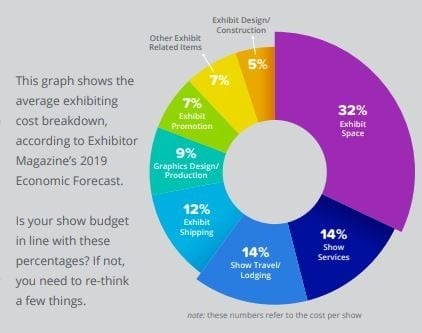
Exhibit space generally represents about one-third of your overall show expenses. The rest comes from booth design, shipping, drayage, installation, and staffing.
To reduce your 2026 costs:
Use lightweight materials to lower freight and drayage fees.
Refresh existing exhibit structures with updated graphics instead of building new.
Optimize staffing—smaller, well-trained teams often deliver better results.
Compare your costs to industry benchmarks from Exhibitor Magazine and other sources.
Partnering with experts like The Tradeshow Network Marketing Group can help identify where to invest for long-term efficiency and savings.
Small oversights can lead to big expenses. For each 2026 event, review the exhibitor manual early to understand deadlines, rules, and potential add-on fees.
Budget-smart tips:
Ship to the advance warehouse to avoid last-minute surcharges.
Combine booth and product shipments where possible.
Eliminate extra counters, tables, or graphics not needed for smaller shows.
Use modular or fabric displays to reduce shipping weight.
Estimate drayage costs early—advance vs. direct shipping can vary dramatically.
Planning ahead helps ensure your 2026 trade show season runs smoothly and stays on budget.
Trade show ROI isn’t just about immediate sales—it’s about long-term value. Start with the basics:
ROI = (Revenue from leads ÷ Total show cost)
But remember to track qualitative success too:
New or expanded customer relationships
Increased brand exposure and awareness
Successful product introductions
Competitive intelligence and insights
When presenting your results, combine hard data with real-world wins. For example: “Our 2026 CES exhibit generated 150 qualified leads and strengthened our relationship with key partners, leading to a 10% increase in Q2 sales.”
2026 is shaping up to be a competitive year for exhibitors. To make the most of it, align your trade show schedule with your company’s growth goals and manage every cost with intention.
By analyzing ROI, prioritizing high-value events, and partnering with experts like The Tradeshow Network Marketing Group, you’ll ensure that your trade show budget delivers measurable results—and positions your brand for even greater success in 2027.
Plan smart. Spend wisely. Win big in 2026.
1 min read
Karin Roberts : Tue, Nov 16, 2021
You are starting the planning process for the year. Your company is doing well but wants to see a 5% growth in sales - especially since you are...
1 min read
Karin Roberts : Tue, Feb 18, 2020
Your in charge of driving leads for the sales team. You have decided that attending a trade show event that brings a large number of your target...
1 min read
Karin Roberts : Tue, Jul 25, 2023
Exhibitions remain a valued sales and marketing channel among event teams and their senior leadership, but global inflation — along with...