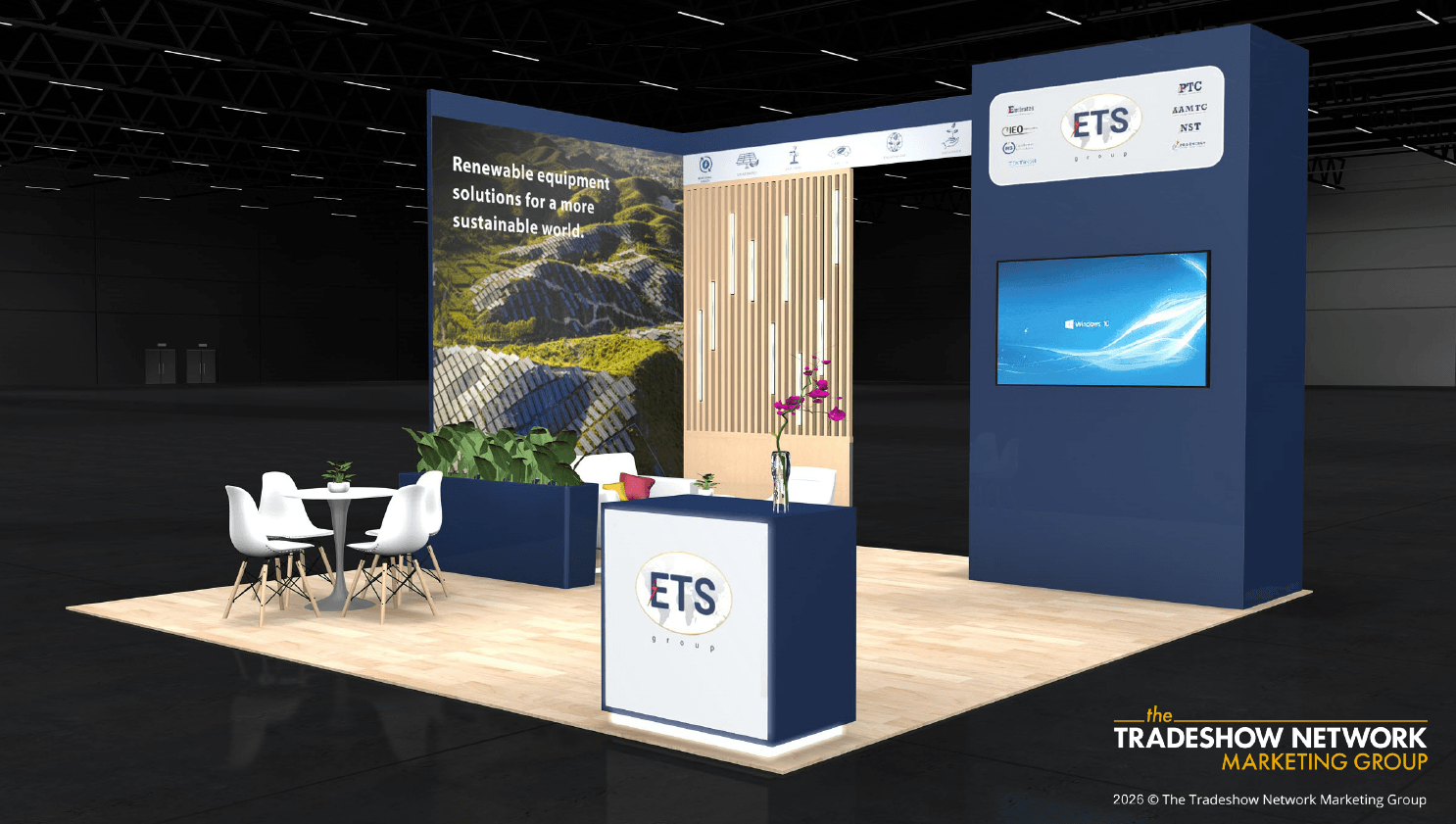
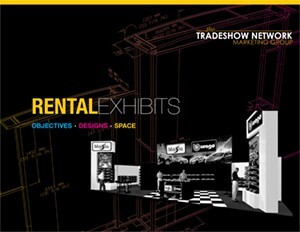
Every year, we sit down with exhibitors who have outgrown their 10×10 or 10×20 space and are ready for the next chapter: a 20×20 or larger island booth. The excitement is always the same — bigger footprint, hanging sign, 360-degree access, a real presence on the show floor. What varies is how prepared each team is for everything that comes with that upgrade. That's where we come in. At The Tradeshow Network, we don't just build islands — we plan the full program around them, so the move up is a smart one, not just an exciting one. Here's the framework we walk every client through before they commit to an island.
Start With the Why, Not Just the Wow
An island booth is a statement. But a statement about what, exactly? Before we design anything, we ask our clients to get specific about what the space needs to accomplish:
- Is it an activation hub for live demos and experiences?

- Does it need to support more staff working more leads at once?
- Is it primarily a visual landmark meant to pull traffic from across the hall?
- Does it need private meeting space, storage, or a hospitality element?
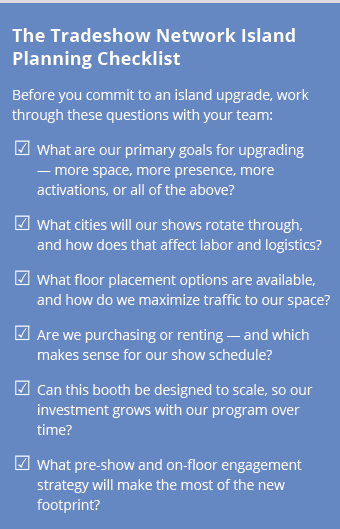
- What are our primary goals for upgrading — more space, more presence, more activations, or all of the above?
- What cities will our shows rotate through, and how does that affect labor and logistics?
- What floor placement options are available, and how do we maximize traffic to our space?
- Are we purchasing or renting — and which makes sense for our show schedule?
- Can this booth be designed to scale, so our investment grows with our program over time?
- What pre-show and on-floor engagement strategy will make the most of the new footprint?
Getting clear on the goal shapes everything downstream — size, layout, features, and where the budget should actually go. We'd rather spend an hour on this conversation up front than redesign a floor plan three times because the “why” wasn't nailed down.
“Out of all the conversations we've had with exhibit partners, The Tradeshow Network was the only one who pushed us to define our goals before talking booth size.”
— Marketing Director, Technology Client
We Plan the Full Program, Not Just the Structure
The booth itself is one line item in a much bigger investment, and one of the most valuable things we do for clients is map out the entire program cost before a single panel gets built. That includes:
Build quality. A well-executed island typically runs in the $250–$300 per square foot range. A 20×20 (400 sq ft) island is a serious investment, and we make sure it's budgeted for correctly from day one — not discovered mid-project.
Rigging. That hanging sign is one of the most powerful visual tools on the floor, and it isn't free. Depending on the city and venue, rigging can run anywhere from $6,000 to $14,000+ per show.
Installation & Dismantle (I&D). Labor costs scale with your footprint and vary dramatically by market. We've seen clients pay under $8,000 for I&D in one city and nearly $20,000 for the same program the following year, simply because the show moved to a different union environment.
Show services. Carpet, electricity, freight, and other services all climb as your square footage does.
Rent vs. own. If you're renting, we factor that cost across your full show calendar. If you're purchasing, we plan for amortization and long-term flexibility so the asset keeps working for you.
Our goal is never to shrink your vision — it's to fund it properly, so you know exactly what you're walking into before you commit to a structure.
“They walked us through every line item before we signed off on anything. No surprise invoices, no scrambling mid-program.”
— VP of Marketing, Healthcare Client
Your Show Schedule Is Part of Your Strategy
This is a conversation we have with nearly every client moving toward an island, because it's the piece that catches teams off guard most often: not every show costs the same to execute, even at identical square footage.
Union labor rules, local labor rates, and venue-specific requirements can shift your I&D costs significantly from one city to the next. If your show calendar rotates — Dallas one year, Anaheim or Las Vegas the next — that's information we build into your program from the start, not something you discover on-site.
Some of our clients strategically deploy their island in lower-cost markets and exhibit with a well-branded inline in higher-cost union cities. Others build the full island program with those city-by-city swings baked into the annual budget. Both approaches work — the right one depends on your goals and your total program spend, and we help you figure out which fits.
Floor Placement and Phased Growth: The Two Things Teams Overlook
Placement matters as much as the booth itself. A prime corner, a main aisle, or proximity to a high-traffic anchor exhibitor can amplify the impact of any booth, island or otherwise. We think about placement strategy right alongside design, so your investment works from every angle of the floor, not just the one facing the entrance.
Growth should be designed in, not bolted on later. If a bigger island is on your roadmap in a few years, we design your current structure with that future state in mind — a modular system that reconfigures and expands, or an inline built on a skeleton that grows into a full island down the line. That way, your investment compounds instead of getting replaced.
“We loved that we didn't have to choose between what we needed now and where we're headed in three years. The Tradeshow Network built us a path, not just a booth.”
— Director of Events, Manufacturing Client
Why Your Exhibit Partner Matters
Moving from an inline to an island isn't just a bigger version of what you've been doing — it's a different discipline. The engineering is more complex, the logistics carry more risk, and the storytelling has to work from four sides instead of one. This is exactly where the right partner earns their keep.
At The Tradeshow Network, that means showing up with more than design sketches. It means a team that has actually managed the rigging permits, the union labor negotiations, and the freight logistics that come with a larger footprint — so your transition is smooth instead of a learning experience on the show floor. It means designers who know how to use 360-degree space to tell your brand's story from every angle, not just repeat the same message four times. And it means having the strategic digital capabilities — video walls, interactive touchpoints, lead-capture integrations — layered in with purpose, not bolted on because “islands have screens now.”
None of that works without the ability to actually build it. Our in-house manufacturing and fabrication team, paired with full-service execution from design through I&D, means the vision your team signs off on is the exhibit that shows up on the floor — no surprises, no compromises, no finger-pointing between vendors.
The payoff for getting this right is real: a bigger, more commanding presence for your brand, a more engaging experience for the attendees who walk in, and a program that actually delivers on the goals you set out with — not just a bigger booth.
If you're considering the move to a larger exhibit, The Tradeshow Network is built to be your single source for it — from our Custom Modular Systems to rentals, custom builds, and digital integration. Our job is to help you make a bigger impact without losing control of your budget, and to make sure every show reinforces the brand and business goals behind it.
The Tradeshow Network Island Planning Checklist
Before you commit to an island upgrade, work through these questions with your team:

The Bottom Line
Moving into a 20×20+ island is one of the most exciting milestones in a trade show program — and with the right planning behind it, it's also one of the most impactful investments your brand can make. Every program is different: your schedule, your goals, your budget, your timeline. The right plan is the one built around your specifics, not a generic template.
That's the conversation we specialize in at The Tradeshow Network. If you're evaluating your next booth move — whether you're ready now or building toward it — we'd love to map out the full picture with you.