


1 min read
Modular Trade Show Booths: Benefits And Applications
Explore the transformative potential of modular trade show booths in revolutionizing your marketing strategies and significantly enhancing your...
8 min read
Karin Roberts
:
September 24, 2026
Most event marketing teams running five or more shows per year still manage their exhibit program like a series of isolated projects. A new booth for the national conference, a rental for the regional event, a last-minute portable for the satellite show. Each one solves a single problem while quietly creating three new ones: redundant fabrication costs, inconsistent brand presence, and a storage invoice that looks worse every quarter. This article breaks down what to evaluate when choosing a modular booth system for a US show calendar, from structural flexibility and material decisions to the logistics math that determines whether your investment actually pays back.
A custom exhibit built for one footprint can be reused at that same footprint, at that same show, year after year. A modular exhibit system is designed from the start
to reconfigure into multiple footprints using interchangeable structural components. The distinction matters because the cost advantage of modular only materializes when your show calendar includes different booth sizes.
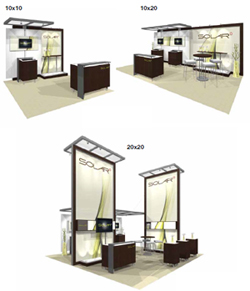
The core concept: one structural kit with standardized connection hardware, lightweight frames, and interchangeable graphic panels that can be assembled into a 10x20 inline at one event and reconfigured into a 20x20 island at the next. The same crates ship to both shows. The same graphics apply to both layouts. The same labor crew assembles both configurations.
According to research from Trade Show Week Magazine, modular exhibits weigh approximately 60% less than traditional custom exhibits on average. That weight difference alone changes the logistics math at every stop on your show calendar, because drayage (the fee venues charge to move your crates from the loading dock to your booth space) is billed by weight and crate count.
Not every exhibitor benefits from modular. If you attend one show per year at the same venue with the same footprint, a well-built custom exhibit may serve you better. The threshold where modular starts delivering clear ROI is typically three or more shows per year with varying booth sizes.
Five signals that your program is a candidate:
If two or more apply, the economics of a unified modular system will likely outperform what you are spending on fragmented builds and rentals today.
The modular exhibit market has a labeling problem. Many systems marketed as reconfigurable are actually product lines with different SKUs for different booth sizes. A genuinely reconfigurable system uses the same structural profiles and connectors across every configuration, from your smallest inline to your largest island.
Three questions to ask any vendor:
Do the same components build every footprint? If a supplier requires different frames for a 10x20 versus a 20x20, you are buying multiple products, not one reconfigurable system. True modular systems use identical connection hardware across all sizes.
Is assembly genuinely tool-free? Tool-free means no power tools, no specialty joiners, no adhesives. If your system requires tools for assembly, factor union labor costs at every show into your total cost of ownership. Many US convention centers require union labor for anything beyond basic pop-up assembly, so tool-free design is not a convenience feature; it directly affects your I&D (install and dismantle) line item.
Can the system achieve the finish quality your brand requires? Reconfigurable does not have to mean generic. Modern modular systems support custom curves, powder-coated finishes in any color, tension fabric graphics with silicone edge (SEG) attachment, integrated LED lighting, and monitor mounts. If your brand standards require a high-end look, make sure the modular system you evaluate can deliver it without custom fabrication workarounds at each show.
Materials drive three cost categories that compound across a multi-show season: freight weight, durability over repeated setup cycles, and storage volume between events.
Lightweight aluminum extrusion frames with tension fabric graphics represent the current standard for multi-show modular systems. The fabric panels use dye-sublimation printing and attach via SEG channels, which allows a complete visual refresh for the cost of new printed fabric panels alone (no structural modification required). When your messaging changes mid-season, you swap graphics without touching the frame system.
Weight matters more than most exhibit managers realize until they see a full season of drayage invoices side by side. A traditional custom wood-and-laminate island booth might require six oversized crates. A modular system covering the same visual footprint might pack into two or three compact wheeled cases. Because drayage is calculated per hundredweight (CWT) at most US venues, that weight reduction hits your budget at every single show stop. For a program running six or more events per season, the cumulative freight and drayage savings alone can offset a meaningful portion of the initial modular system investment within the first year.
Storage volume follows the same logic. Compact cases that stack vertically in a warehouse take up a fraction of the floor space that oversized custom crates require. When you are paying monthly warehouse fees between shows, that footprint reduction translates directly to lower carrying costs.
One underappreciated advantage of a unified modular system is forced brand consistency. When every show uses the same structural vocabulary and the same graphic production workflow, your brand looks and feels cohesive from a regional 10x10 to a flagship island, even when the layouts differ significantly.
The key is designing your graphic hierarchy around the reconfiguration plan from the start. That means:
Your primary brand elements (logo placement, brand colors, hero messaging) live on panels that appear in every configuration. Secondary messaging panels are designed as modular add-ons that appear only in larger footprints. Configuration-specific graphics (directional signage, show-specific promotions) are produced as low-cost swap panels that change between events.
This approach treats your exhibit graphics like a design system rather than a series of one-off print jobs. The result is a consistent brand presence at every show without the cost of commissioning new graphic design for each configuration.
US-based exhibit programs face logistics considerations that differ from European or Asian markets. Understanding these before selecting a modular system will prevent costly surprises mid-season.
Union labor rules vary by venue and city. Some convention centers require union labor for any exhibit assembly beyond what one person can carry and set up unassisted. Tool-free modular systems reduce union labor hours because the assembly is faster and requires fewer specialists, but you still need to plan for mandatory labor minimums at certain venues. Your exhibit partner should provide venue-specific labor estimates for each show on your calendar before you commit.
Shipping routing between shows creates scheduling dependencies. When shows are spaced two weeks apart, your exhibit needs to ship directly from venue to venue rather than returning to the warehouse between events. Compact crate dimensions and standardized packing sequences become critical here, because freight carriers charge by dimensional weight and tight turnarounds leave no room for re-packing at the warehouse. A well-designed modular system includes crate layouts engineered for both scenarios: warehouse-to-venue and venue-to-venue direct ship.
Storage hub locations relative to your show calendar matter. If most of your shows are on the East Coast but your exhibit partner warehouses in Los Angeles, freight costs will eat into your modular savings. TTNMG maintains warehouse operations in the Chicago metro area, which provides relatively central US routing for national programs and reduces average freight distances to major convention cities.
The rent-versus-buy decision for modular exhibits is not binary. Many successful multi-show programs use a hybrid approach: purchase the core structural components you use at every show and rent supplemental elements that only appear at your largest events.
Purchase makes sense for components with high reuse frequency: your primary frame structure, brand-specific graphic panels, branded counters, and core lighting. These elements appear at every show regardless of footprint size, so amortizing their cost across the full season delivers the best per-show economics.
Rental makes sense for components that appear only in expanded configurations: additional wall structures for island shows, specialty furniture for meeting areas, large-format LED or monitor arrays for flagship events. Renting these on an as-needed basis avoids storage costs for components that might sit in a warehouse eight months of the year.
TTNMG offers both paths from the same inventory, which means your rental additions are visually and structurally matched to your purchased core. That eliminates the patchwork look that can result from sourcing rental pieces from a different vendor than your primary exhibit.
The right answer depends on your show frequency, configuration variation, and budget cycle. A program with eight shows at three footprint sizes will have a different ideal split than a program with four shows at two sizes.
Choosing a modular booth system is ultimately a logistics decision disguised as a design decision. The companies that get the most value from their exhibit programs are the ones that evaluate structural flexibility, material weight, shipping logistics, and reconfiguration workflow as a connected system rather than separate line items. When those four elements align, a single modular investment outperforms the accumulated cost of managing separate builds, separate vendors, and separate shipping plans for every show on the calendar. Your next show season starts with a design conversation, not a purchase order.
+ What is a modular trade show booth system?
A modular trade show booth system is an exhibit built from interchangeable structural components that can be configured into different booth sizes and layouts. One modular system can be reconfigured for multiple shows, such as a 10x20 inline, 20x20 island, or larger exhibit.
+ Are modular trade show exhibits worth the investment?
For companies exhibiting at multiple shows each year, modular exhibits can reduce the need for separate booth builds while lowering shipping, storage, and reconfiguration costs. The value increases as the number of shows and booth configurations increases.
+ What booth sizes can a modular exhibit accommodate?
Depending on the system, modular exhibits can be configured for multiple footprints, including 10x10, 10x20, 20x20, and larger island exhibits. A true reconfigurable system uses the same core structural components across different configurations.
+ Can modular trade show booths look custom?
Yes. Modern modular exhibits can include custom finishes, tension fabric and SEG graphics, integrated lighting, monitor mounts, curved elements, branded counters, and other design features. A modular exhibit does not have to look generic.
+ Can I change the graphics without replacing the entire booth?
Yes. Graphic panels can typically be replaced while the structural framework remains in use. This allows exhibitors to update messaging, products, promotions, or campaigns without purchasing an entirely new exhibit.
+ Are modular exhibits easier to ship and store?
Generally, yes. Modular systems are designed to pack into compact cases or crates and can be considerably lighter than traditional custom-built exhibits. Smaller shipping and storage footprints can help reduce freight, drayage, and warehouse costs.
+ Can a modular exhibit be shipped directly from one trade show to another?
Yes. A properly designed and packed modular system can be shipped directly from one show to the next. This can be especially valuable when shows are scheduled close together and there is not enough time to return the exhibit to a warehouse.
+ Should I buy or rent a modular trade show exhibit?
Many exhibitors use a combination of both. Frequently used components can be purchased, while additional structures, furniture, meeting areas, LED displays, or other elements needed only for larger shows can be rented.
+ How many trade shows should I attend before considering a modular exhibit?
Modular systems are particularly worth evaluating for companies exhibiting at three or more shows per year, especially when those shows require different booth footprints.
+ Do modular exhibits require union labor?
Labor requirements vary by convention center and city. Some U.S. venues require union labor for certain exhibit installation and dismantling activities. A tool-free modular system can reduce assembly time, but venue-specific labor requirements still need to be considered.
+ How long does a modular trade show exhibit last?
The lifespan depends on the quality of the system, frequency of use, packing methods, and maintenance. A well-designed modular exhibit can be used across many shows and multiple seasons, while graphics and individual components can be updated as needed.
+ Can one modular exhibit maintain consistent branding across different booth sizes?
Yes. A modular exhibit can be designed so that core brand elements appear in every configuration, while additional graphics, messaging, product displays, and meeting areas are added as the booth footprint increases.
+ What should I look for when choosing a modular exhibit company?
Look for a company that offers genuinely interchangeable components, high-quality graphics and finishes, efficient assembly, and a complete plan for shipping, storage, and reconfiguration. Your exhibit partner should be able to support your overall show program rather than simply build a booth for one event.
+ Can a modular exhibit be expanded later?
Yes. Additional components can often be added as your trade show program grows. A company might start with a 10x20 configuration and later expand to a 20x20 island or larger exhibit without replacing the entire system.
+ Is a modular exhibit a good option for a nationwide trade show program?
It can be especially effective for companies exhibiting at multiple U.S. convention centers. Efficient shipping, compact storage, repeatable packing, and easy reconfiguration can make managing a nationwide exhibit program much simpler.
+ What is the biggest advantage of a modular trade show booth?
The biggest advantage is flexibility. One core exhibit investment can support multiple booth sizes, shows, graphics, and configurations. Instead of treating every trade show as a separate exhibit project, a modular system allows your exhibit program to work as one connected system.
1 min read
Explore the transformative potential of modular trade show booths in revolutionizing your marketing strategies and significantly enhancing your...
1 min read
With so many trade show display options available these days, finding the right exhibit for all your shows can seem next to impossible – unless you...
1 min read
CHICAGO – August 5, 2014 – The Tradeshow Network Marketing Group has updated its website at www.thetradeshownetwork.com to be more user friendly for...